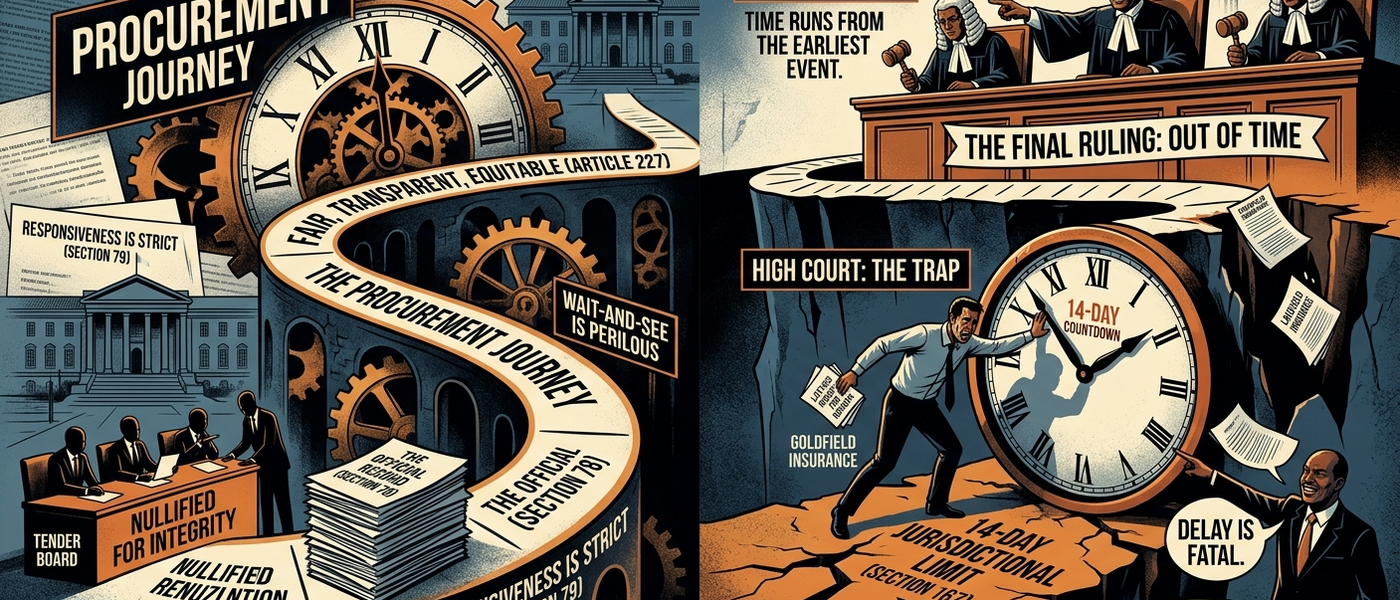
The 14-Day Trap: A Procurement Journey from PPARB to the Court of Appeal
Public procurement is often spoken of in the language of rules, of statutes, timelines, and procedures neatly arranged within the framework of the law. Yet beneath this structured order lies something far less mechanical and far more exacting. It is a system that moves with its own rhythm, where every step must be taken in time, and every silence may carry consequence.
In this space, a moment overlooked can outweigh a case well argued. A delay, however slight, can eclipse even the strongest claim. Like a clock that does not pause, procurement law advances steadily, indifferent to intention, unmoved by effort.
The journey of Goldfield Insurance Brokers Limited V The County Government of Nyeri, from the PPARB, through the High Court, and ultimately to the Court of Appeal, unfolds within this rhythm. It is not merely a dispute about a tender. It is a story about time, about process, and about the quiet but decisive truth that in procurement, one does not simply lose on the merits, one may lose by missing the moment.
The Origin of the Dispute
The dispute arose during the tender opening stage of a procurement process for medical insurance services. At that stage, a key compliance issue emerged regarding the amount of tender security submitted by one of the bidders.
The law is clear on what happens at tender opening. Under Section 78(6) of the Public Procurement and Asset Disposal Act, 2015, certain details must be read out and recorded publicly, including the name of the bidder and the tender price. In practice, this process extends to critical compliance elements such as tender security, which form part of the official procurement record.
However, shortly after the opening session had concluded, the procuring entity attempted to “correct” what had been read out. Through informal communication, it indicated that the bidder in question had in fact submitted the correct tender security.
This created a fundamental legal tension. On the one hand, there was the official record established during a transparent and public process. On the other, there was a subsequent attempt to revise that record outside the formal framework provided by the law.
The PPARB: Protecting the Integrity of the Process
When the matter reached the PPARB, the Board approached it from the perspective of process integrity. Anchored in Article 227(1) of the Constitution, which requires procurement systems to be fair, transparent, and equitable, the Board emphasized that the tender opening stage is not a procedural formality but a cornerstone of accountability.
The Board held that what is read out and recorded at tender opening constitutes the official and verifiable record of the procurement process. Any attempt to alter that record after the fact, particularly through informal means, undermines transparency and equal treatment of bidders.
In applying Section 79(1) of the Act, which defines a responsive tender as one that meets all mandatory requirements, the Board underscored that compliance must be assessed strictly on the basis of the record as established during the process.
On this reasoning, the Board nullified the entire procurement process.
The High Court: When Time Becomes the Issue
The matter did not end with the Board’s decision. It proceeded to the High Court, where the focus shifted from the substance of the procurement process to a more foundational question, whether the challenge had been brought within time.
The governing provision, Section 167(1) of the Act, allows a candidate or tenderer to seek administrative review within fourteen days of either the notification of award or the occurrence of the alleged breach at any stage of the procurement process.
The Court examined the facts and found that the alleged breach had occurred at the tender opening stage. The bidder was aware of it at that point. However, the bidder chose not to act immediately. Instead, it waited until after the notification of the award to file a request for review.
The Court held that this delay was fatal. Time, in its view, began to run from the date of the occurrence of the breach. By the time the request for review was filed, the fourteen-day period had already lapsed.
The consequence was decisive. The PPARB, having been approached outside the statutory timeframe, lacked jurisdiction to entertain the matter. Its proceedings were therefore rendered a nullity.
The Court of Appeal: Settling the Law on Timelines
On appeal, the Court of Appeal addressed the interpretation of Section 167(1) and provided definitive clarity.
The Court held that the provision creates multiple trigger points for the commencement of the fourteen-day period, namely, the occurrence of the breach and the notification of the award. However, it emphasized that time begins to run from the earliest of these events.
This interpretation carries significant practical implications. A bidder who becomes aware of an irregularity at any stage of the procurement process cannot defer action in anticipation of a later outcome. The right to challenge arises immediately upon discovery of the breach.
The Court further clarified the relationship between this provision and Section 78(7), which states that no tender shall be rejected at the tender opening stage. It held that while this provision prevents disqualification at that stage, it does not preclude a bidder from challenging a breach that occurs during the process.
In the final analysis, the Court concluded that the request for review had been filed out of time. The appeal was dismissed.
Lessons from the Litigation
This case reveals several important principles about the operation of public procurement law.
First, time in procurement is not merely procedural, it is jurisdictional. The fourteen-day period under Section 167(1) is a strict statutory limit. Once it lapses, the right to seek review is extinguished, and no adjudicative body has the authority to revive it.
Second, the law does not accommodate a “wait and see” approach. The moment a bidder becomes aware of a breach, the obligation to act arises. Waiting for the outcome of the procurement process may seem practical, but it is legally perilous.
Third, the integrity of the procurement process must be preserved at every stage. The tender opening process, governed by Section 78, establishes an official record that cannot be altered informally. Any deviation from this framework risks invalidating the entire process.
Fourth, compliance remains central. Under Section 79(1), responsiveness is determined strictly by reference to mandatory requirements. It is not a matter of intention or subsequent explanation, but of objective conformity with the tender document.
Finally, the case reinforces the limited role of the courts. Judicial review is concerned with the legality of the process, not the merits of the outcome. Courts will not substitute their judgment for that of procurement entities or evaluation committees.
Conclusion
This litigation journey demonstrates that public procurement is governed as much by time as it is by substance. A bidder may identify a genuine irregularity. The process may indeed have been flawed. Yet, if the challenge is not brought within the prescribed timeframe, the law provides no remedy.
In that sense, procurement law demands vigilance, precision, and prompt action. It does not reward delay, however justified it may appear.
Ultimately, the lesson is clear. In public procurement, rights are not only defined by what the law permits, but also by when one chooses to act.